LLC vs DBA: Key Differences Every Business Owner Needs to Know in 2026
Disclosure: Some of the links in this article are affiliate links, meaning we may earn a commission if you click through and make a purchase, at no additional cost to you. We only recommend services we've researched and believe will be genuinely helpful.
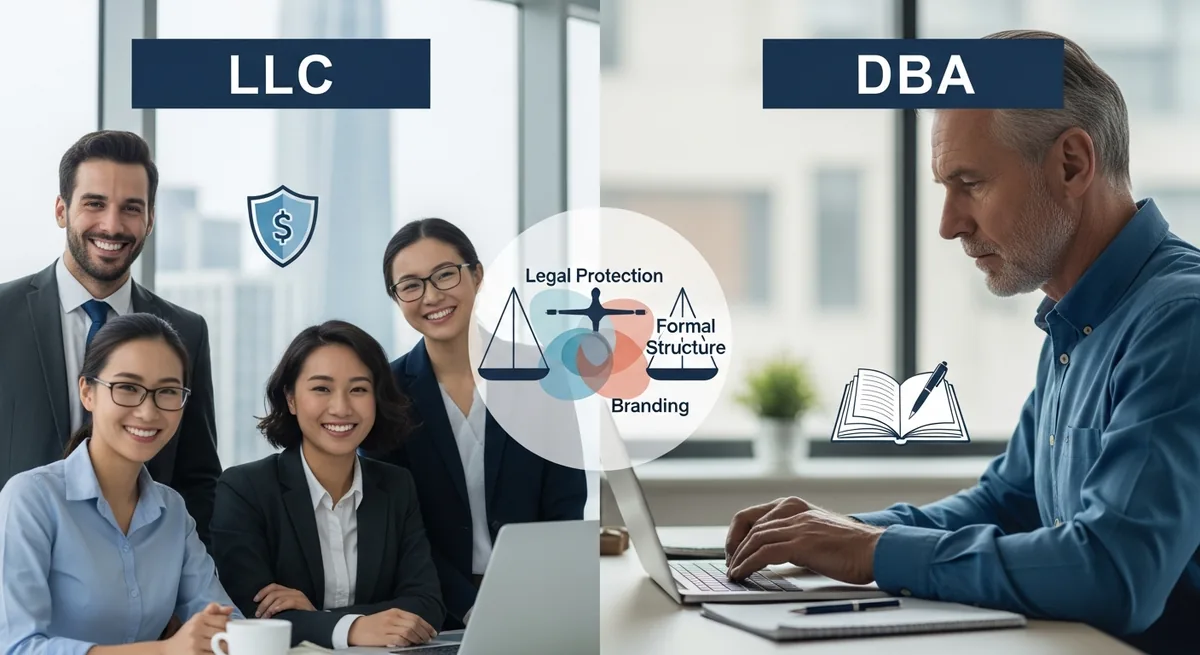
If you’re starting a business and trying to decide between a DBA (doing business as) and a formal LLC, you’re dealing with one of the most consequential — and most misunderstood — decisions in early-stage business formation. Get it wrong, and you could spend years believing you’re protected when you’re not.
The core distinction is this: a DBA is a name you operate under; an LLC is a legal entity that actually protects you. Understanding the LLC vs DBA differences before you file anything could save you tens of thousands of dollars in personal liability exposure down the road.
Forming an LLC is also more accessible than most people realize. ZenBusiness — our top-rated formation service — starts at $0 plus your state’s filing fee, with the entire process completable online in under 20 minutes. But the right choice between an LLC and a DBA depends on your specific situation, and this guide walks you through exactly how to make that call.
What Is a DBA and What Does It Actually Do?
A DBA — short for “doing business as” — is a registered trade name that allows an individual or existing business entity to operate publicly under a name other than their legal name. Depending on your state, you’ll also hear it called a fictitious business name, an assumed name, or a trade name. The terminology varies, but the mechanics are largely the same everywhere.
Here’s a simple example: if Marcus Williams wants to open a landscaping business called “Green Horizon Outdoors” without forming a corporation or LLC, he can register “Green Horizon Outdoors” as a DBA under his personal name. Legally, Marcus and Green Horizon Outdoors are the same person — no separation exists between them.
What DBA registration actually involves:
In most states, DBA registration is handled at the county level, though some states (including Texas and California) also have a state-level component. The process is simple:
- Complete a short form with the county clerk or state agency
- Pay a filing fee — typically $10–$100
- Publish a legal notice in a local newspaper (required in states including California and New York — the publication cost can run $40–$200 depending on circulation)
- Renew the registration every 1–5 years
In 2026, DBA filing fees remain modest. A DBA in Texas costs roughly $25 per county; California charges around $26 at the county level plus that newspaper requirement. This low cost is part of why DBAs are appealing — but it’s also why they shouldn’t be confused with actual business protection.
What a DBA does NOT do:
This is the critical part. A DBA does not:
- Create a new legal entity
- Provide any liability protection whatsoever
- Separate your business debts from your personal assets
- Change how you’re taxed (you’re still filing as a sole proprietor on Schedule C)
- Grant exclusive rights to the business name in most states (another entity could register a similar DBA in a neighboring county)
A DBA is a name tag. It’s useful for branding purposes, but it offers none of the legal protections that make a formal business structure worth having.
What Is an LLC and How Is It Different?
A Limited Liability Company (LLC) is a formal legal entity created by filing Articles of Organization with your state government. Unlike a DBA, an LLC actually exists as a separate legal person — it can own property, enter contracts, open bank accounts, hire employees, and be sued independently of its owners (called members).
For a deeper primer on how the structure works, see our guide on what an LLC is and how it works.
What an LLC actually gives you:
1. Personal liability protection. If your LLC is sued or can’t pay its debts, your personal assets — your home, car, savings account — are generally shielded from creditors. This is the core value proposition and the reason most business owners choose to form an LLC. Note that courts can “pierce the corporate veil” if you commingle personal and business funds or fail to maintain the LLC properly — which is why keeping separate bank accounts and basic records matters.
2. Tax flexibility. By default, a single-member LLC is taxed as a sole proprietor (pass-through taxation — no separate corporate tax return). But once your LLC generates meaningful profit, you can elect S-Corp treatment with the IRS, potentially saving thousands annually in self-employment taxes. The IRS provides detailed guidance on LLC tax elections at IRS.gov. This flexibility simply isn’t available to a sole proprietor operating under a DBA.
3. Business credibility. Having “LLC” after your business name signals to clients, vendors, and partners that you’re a legitimate, formally organized business. Many B2B customers and enterprise clients require vendors to be registered entities before signing contracts.
4. Easier business banking. Banks routinely open business checking accounts for LLCs with minimal friction. Sole proprietors operating under a DBA often face more documentation requirements and have fewer account options available.
5. Continuity and transferability. An LLC continues to exist even if ownership changes, unlike a sole proprietorship that’s tied entirely to the individual owner.
LLC vs DBA: The Key Differences at a Glance
Here’s a direct comparison of the LLC vs DBA differences that matter most for practical decision-making:
| Feature | LLC | DBA |
|---|---|---|
| Creates a legal entity | Yes | No |
| Personal liability protection | Yes — assets generally shielded | No — fully personally liable |
| Federal tax treatment | Flexible: pass-through default, S-Corp election available | Sole proprietor only (Schedule C) |
| Cost to register | $40–$520 state fee + service/agent costs | $10–$100 filing fee |
| Annual maintenance | Annual reports required in most states | Renewal required in some jurisdictions |
| Business bank account | Straightforward with EIN | Possible but often more friction |
| Name protection | Generally statewide exclusivity | Often county-level only; not exclusive |
| Professional credibility | High — “LLC” signals legitimacy | Lower — appears as an individual |
| Can own property in its own name | Yes | No — ownership stays with the individual |
The fundamental gap is liability protection. A DBA offers exactly zero separation between your business activities and your personal financial life.
When a DBA Makes Sense
There are legitimate use cases for a doing business as registration — but they’re more limited than most people assume.
1. You already have an LLC or corporation and want a trade name. This is actually the most common and strategically sound use of a DBA. If your LLC is “Torres Digital Solutions LLC” but you want to market services under “Apex Growth Studio,” you can register “Apex Growth Studio” as a DBA under your existing LLC. You get branding flexibility without sacrificing any of your legal protections. All contracts, bank accounts, and liability still flow through the LLC.
2. You’re testing a business concept before committing. Running a weekend pop-up or a small side project at minimal scale? A $25 DBA registration lets you test market demand under a business name without the full cost of formal entity creation. That said, even a small business can generate legal exposure from day one.
3. Your bank requires it for check deposits. Some banks require a DBA certificate before they’ll accept checks made out to a business name that differs from your legal name. This is a documentation requirement, not a structural choice — and it’s often needed even if you already have an LLC.
What you should not use a DBA for: Avoid relying on a DBA as your primary business structure for any venture with real financial stakes, client-facing services, or physical products. The exposure is simply not worth the filing fee savings.
When You Should Form an LLC Instead
In my experience reviewing hundreds of business formation decisions, the most common mistake I see is business owners choosing a DBA because it’s cheaper upfront — and then running into a contract dispute, a client lawsuit, or an unpaid vendor situation that exposes their personal finances entirely. The cost difference between a DBA and an LLC is rarely more than $100–$200. The difference in protection can be your life savings.
You should form an LLC when:
- You’re providing professional services — consulting, freelancing, design, coaching — where a client could sue you for errors, missed deadlines, or non-delivery
- You’re working with physical products where injury or defect claims are possible
- You’re signing business contracts — as an LLC, those contracts bind the entity, not you personally
- You want to build business credit separate from your personal credit profile
- You plan to bring on a partner or investor — LLC operating agreements formally document ownership percentages and rights in a way a DBA cannot accommodate
- You want tax planning flexibility — particularly the S-Corp election, which can save $5,000–$20,000+ per year once your business generates meaningful profit
If you’re currently operating as a sole proprietorship and weighing the upgrade, our guide on LLC vs sole proprietorship walks through the full cost-benefit analysis. And if you’re still on the fence about whether an LLC is necessary for your specific situation, see our guide on whether you need an LLC for your business.
The U.S. Small Business Administration identifies liability risk as the primary factor in choosing a business structure — and for any business where customers, contracts, or debt are involved, that analysis almost always points toward an LLC.
Can You Have Both an LLC and a DBA?
Yes — and this combination is often the smartest setup for businesses that need branding flexibility without sacrificing legal protection.
Here’s how it works:
- You form an LLC (e.g., “Rivera Creative Partners LLC”)
- You register a DBA under that LLC (e.g., “Marble + Ink Studio”)
- All contracts, bank accounts, tax filings, and legal documents flow through the LLC
- You market and operate publicly under “Marble + Ink Studio”
Your clients interact with “Marble + Ink Studio,” but legally they’re dealing with your LLC. The liability protection stays intact.
To add a fictitious business name to an existing LLC, you file the same DBA registration form with your county or state — just list the LLC as the registrant rather than your personal name. Many states charge the same $10–$100 filing fee regardless of whether it’s an individual or an entity registering the name.
This structure is especially useful for LLCs that want to operate multiple brand lines under one entity — for example, a consulting firm operating both a client-facing brand and a training program under different names, but with only one set of books and one annual report.
The Real Cost Comparison in 2026
Let’s put concrete numbers on the LLC vs DBA decision, because the price gap is often smaller than people assume.
DBA costs in 2026:
- County/state filing fee: $10–$100 (most common: $25–$50)
- Newspaper publication where required: $40–$200+
- Renewal (every 1–5 years): similar cost
- Estimated first-year total: $25–$300
LLC costs in 2026:
- State filing fee: $40–$520 (average is roughly $100–$130 for most states)
- Registered agent: $0–$125/year (included free in year one by most major formation services)
- Formation service fee: $0–$299 (service charge only; state fees billed separately)
- Annual report fee: $0–$500/year depending on state
- Estimated first-year total: $100–$800+
The price difference is real — but so is what you’re getting. An LLC’s liability protection, potentially shielding a lifetime of personal assets from business claims, is worth the additional cost for virtually every business that has any meaningful exposure.
Formation service comparison:
ZenBusiness is our top recommendation for most business owners. Their Starter plan includes LLC formation at $0 (plus your state’s filing fee), a registered agent for the first year, and a basic operating agreement template. Their Pro plan ($199/year + state fees) adds an EIN, a full operating agreement, and compliance monitoring to alert you when annual filings are due. The Pro tier is worth considering if you want a hands-off compliance experience.
LegalZoom also offers a $0 service-fee formation tier, but their checkout experience includes persistent upsells for add-ons that many customers end up purchasing as if they’re required. Customers who add LegalZoom’s registered agent service face $249/year after year one — compared to ZenBusiness’s $119/year — and the total cost of a “basic” formation with LegalZoom often lands $150–$300 higher than the advertised entry price. For a detailed head-to-head comparison, see our ZenBusiness vs LegalZoom analysis.
For a full state-by-state breakdown of what you’ll actually pay in fees, see our guide on how much an LLC costs. And if you want a ranked comparison of formation services across price, speed, and support quality, our best LLC formation services guide covers everything you need.
Frequently Asked Questions: LLC vs DBA
Does a DBA protect my personal assets?
No. A DBA (doing business as) registration creates no legal separation between you and your business. If your business incurs a debt or a client sues you, your personal assets — home, savings, vehicles — are fully exposed. Only a formal legal entity like an LLC provides that separation.
How much does a DBA cost compared to an LLC?
A DBA typically costs $10–$100 in filing fees, plus $40–$200 for newspaper publication where required. An LLC costs $40–$520 in state filing fees, plus optional service and registered agent fees. The first-year cost of an LLC through a service like ZenBusiness is often $100–$200 all-in (plus state fees) — not dramatically more than a DBA in many states.
Can I open a business bank account with just a DBA?
Some banks will open an account for a sole proprietor with a DBA certificate and a Social Security number, but many banks prefer or require an EIN and formal entity documentation. LLCs with an EIN consistently face fewer hurdles when opening business checking accounts. Keeping personal and business finances separate is also essential for maintaining your LLC’s liability protection.
Do I need to renew a DBA?
Yes, in most jurisdictions. DBA registrations typically expire after 1–5 years and must be renewed. Some states require biennial renewal; others allow five-year terms. Failing to renew can cause the registration to lapse — potentially voiding your right to operate under that name.
Is a DBA the same as an LLC?
No — they’re fundamentally different tools. A DBA is a name registration that creates no legal entity and no liability protection. An LLC is a formal legal entity recognized by the state that shields members from personal liability, allows flexible tax treatment, and can own assets and enter contracts in its own name.
Can my LLC have a DBA?
Yes, and this is a common and effective setup. Your LLC can operate under one or more trade names (DBAs) by registering the fictitious business name under the LLC rather than your personal name. All legal and financial protections remain intact — you simply do business publicly under a different name.
What happens if I operate under a DBA without registering it?
Using an unregistered fictitious business name is a civil violation (and in some states, a misdemeanor). Beyond the legal penalty, you may be unable to enforce contracts in court or open bank accounts under that name. Always register your DBA before operating publicly under it.
Should I start with a DBA and upgrade to an LLC later?
This approach is tempting because it delays cost, but it carries real risk. If anything goes wrong while you’re operating as an unprotected sole proprietor — a lawsuit, an unpaid invoice you can’t collect, a product claim — your personal assets are exposed for that entire period. In 2026, with services like ZenBusiness offering $0 formation fees (plus state costs), starting with an LLC from day one has never been more accessible or affordable.
The Bottom Line
The LLC vs DBA differences come down to a simple distinction: a DBA is a name; an LLC is a shield.
For any business with real financial stakes — clients, contracts, products, employees, or significant revenue — a DBA alone is not a sufficient structure. The cost difference between registering a DBA and forming an LLC has narrowed considerably in 2026, and the gap in protection between the two is enormous.
For most business owners, the right path is to form an LLC first, then register a DBA under that LLC if you need a different public-facing name. ZenBusiness is our top pick for formation — starting at $0 plus your state’s filing fee, with a clean process and solid post-formation compliance support.
If you’re still comparing your options before committing, our best LLC formation services guide covers the leading providers in detail across pricing, speed, and support quality.
The author name used in this article may be a pen name or pseudonym and is used for illustrative and editorial purposes only. This article is for informational purposes only and does not constitute investment, tax, or legal advice. Consult qualified professionals — including a licensed attorney and a certified tax advisor — before making business formation or financial decisions.

Sarah Mitchell
Sarah has researched and tested over 20 LLC formation services since 2021. She has personally formed LLCs in 5 states.