LLC Pros and Cons: The Complete List Every Business Owner Needs in 2026
Disclosure: Some of the links in this article are affiliate links, meaning we may earn a commission if you click through and make a purchase, at no additional cost to you. We only recommend services we've researched and believe will be genuinely helpful.
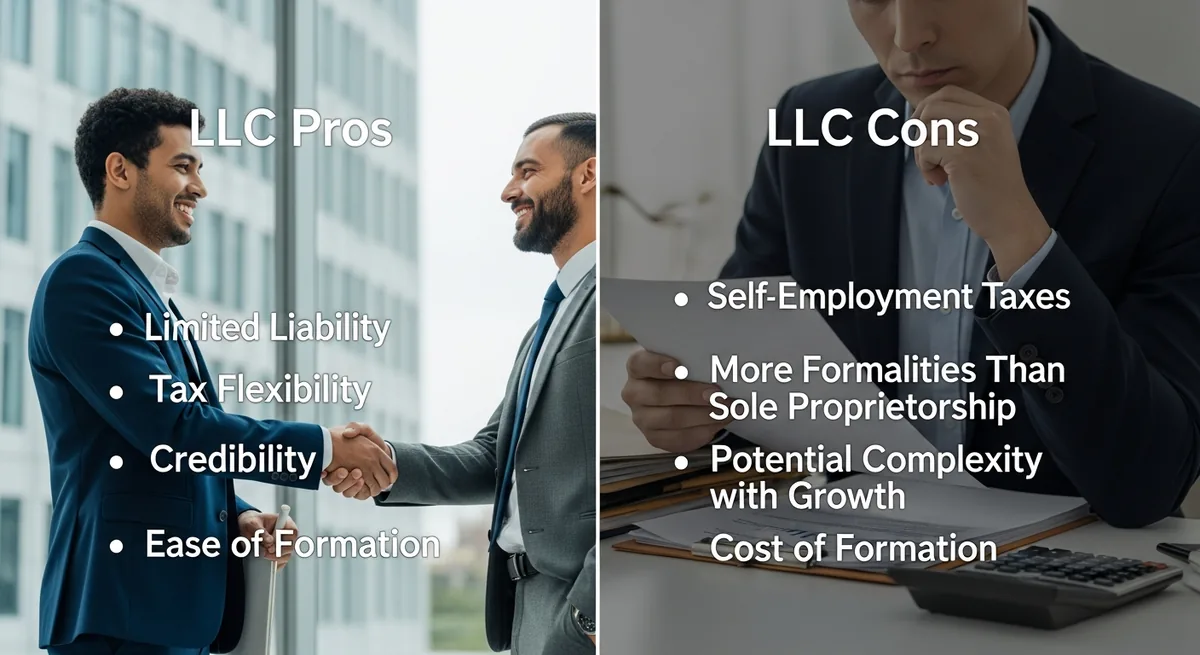
Every week, I talk to business owners who made the same avoidable mistake: they formed an LLC without really understanding what it protects them from — and what it doesn’t. Or they stayed a sole proprietor for years assuming an LLC was too complicated or expensive, only to face a lawsuit that wiped out their personal savings. In my experience, both mistakes stem from the same gap: nobody handed them a clear, complete picture before they decided.
This LLC pros and cons complete list is designed to close that gap. Whether you’re a freelancer considering your first business entity, a landlord thinking about property protection, or a growing startup weighing your options, you’ll find the honest breakdown here — no fluff, no scare tactics.
If you already know you’re ready to form an LLC, ZenBusiness is where most business owners should start. Their Starter plan forms your LLC for the cost of the state filing fee only (typically $50–$500 depending on your state), and they include a registered agent free for the first year — a $49–$125 value that LegalZoom charges extra for from day one. But let’s make sure an LLC is actually the right move for you first.
What Is an LLC? (A Quick Primer)
A Limited Liability Company (LLC) is a business entity created at the state level. You file articles of organization with your state’s secretary of state, pay a filing fee, and your LLC legally exists. From that point forward, it’s a distinct legal entity — separate from you as an individual.
LLCs were specifically designed to solve two problems that plague unprotected business owners: unlimited personal liability exposure and unfavorable default tax treatment. Whether an LLC solves your problems depends entirely on your specific situation — which is exactly what this LLC pros and cons complete list is here to help you assess.
For a deeper explanation of how LLCs work and what they can do for you, see our guide on what an LLC is.
The Complete List of LLC Advantages
1. Personal Liability Protection
This is the single most important reason people form an LLC, and it’s genuinely powerful — when properly maintained.
As a sole proprietor, your personal assets are fully exposed if your business gets sued or can’t pay its debts. Your home, savings, investment accounts, and car are all fair game for creditors. An LLC creates a legal wall between you personally and your business. If your LLC faces a $400,000 lawsuit and loses, creditors can generally only pursue LLC assets — not yours.
The IRS confirms that LLC members are ordinarily not personally responsible for business debts or judgments. LLC liability protection is the foundational reason this entity type exists.
Concrete example: A freelance web developer working through an LLC gets sued for $75,000 after a client claims the project caused them business losses. Without an LLC, the developer’s personal savings and assets are exposed. With a properly maintained LLC, only the business’s assets are at risk.
2. Pass-Through Taxation — No Double Taxation
By default, an LLC is taxed as a pass-through entity. The business itself pays no federal income taxes. Instead, profits and losses flow directly to the members’ personal tax returns and are taxed once at individual rates.
This is a major advantage over C-Corporations, where profits are taxed at the corporate level (currently a flat 21% in 2026) and then taxed again when distributed to shareholders as dividends — the famous “double taxation” problem that makes C-Corps unattractive for small businesses.
LLC tax benefits extend further: a single-member LLC files on Schedule C by default (no separate business return needed), while a multi-member LLC defaults to partnership taxation. And if your net profits are substantial enough, you can elect S-Corp tax status for your LLC — a powerful move that can save thousands annually in self-employment taxes.
3. Flexible Management Structure
LLCs don’t require the rigid governance structure that corporations do. No mandatory board of directors, no formal annual shareholder meetings, no complex bylaws. You define how your LLC operates through an operating agreement that you draft yourself.
You can run it as member-managed (all owners participate in decisions) or manager-managed (you designate a specific person — who may or may not be a member — to handle day-to-day operations). This flexibility is particularly useful for investment groups, family businesses, and LLCs with passive investors.
4. Professional Credibility
“LLC” after your business name communicates that you’re operating a registered, legitimate business — not an informal side hustle. This matters more than people expect in 2026.
Many corporate clients, government contractors, and wholesale suppliers won’t engage with unregistered sole proprietors. Banks are more receptive to business credit applications from LLCs with EINs. Clients signing contracts feel more confident working with an LLC than with an individual operating under a DBA.
5. Fewer Formalities Than a Corporation
Corporations — especially C-Corps — carry significant ongoing administrative burden: board meetings, shareholder records, formal meeting minutes, resolutions for major decisions. LLCs largely bypass these requirements. There’s no mandate to hold annual meetings or maintain minute books (though documenting major decisions internally is still wise practice).
This makes the LLC the practical choice for small business owners and solopreneurs who want liability protection without corporate-level compliance overhead.
6. Flexible Profit Distribution
In a traditional partnership or S-Corp, profits are split proportionally to ownership percentages. LLC members can deviate from this through the operating agreement — distributing profits in ways that reflect each member’s actual contribution, risk, or role, regardless of their ownership percentage.
If one member contributed capital and another contributed labor and expertise, the operating agreement can specify different distribution percentages without matching ownership splits. This flexibility is invaluable for small multi-member businesses.
7. Multiple Members, Broad Ownership Options
Unlike a sole proprietorship, an LLC can have multiple members. And the ownership options are genuinely broad: individuals, corporations, other LLCs, trusts, and — in most states — foreign nationals can all be LLC members. This makes the LLC suitable for partnerships, family businesses, real estate investment groups, and international ventures.
8. Easy to Form and Maintain
Forming an LLC in most states involves three core steps: choose a name, file articles of organization, appoint a registered agent. The process takes minutes when you use a formation service, and hours at most when filing directly with your state.
Services like ZenBusiness or LegalZoom handle the filing for you. ZenBusiness’s free Starter plan covers state filing with no markup on the state fee. LegalZoom’s comparable entry package also starts at $0 plus state fees, but tends to push add-ons more aggressively through the checkout process — a minor but notable user experience difference.
The Complete List of LLC Disadvantages
1. Formation and Ongoing LLC Formation Costs
This is the most underestimated entry in any LLC pros and cons complete list. Forming an LLC isn’t just a one-time expense — it creates recurring obligations.
- State filing fee: $50 (Wyoming, New Mexico) to $500+ (Massachusetts)
- Annual report or renewal fees: Most states require these annually; fees range from $25 to $325+
- Registered agent fees: Required in all 50 states; commercial registered agents charge $49–$299/year. Northwest Registered Agent charges $125/year standalone; ZenBusiness bundles the first year free with paid plans
- Operating agreement: Free if self-drafted; $150–$500+ if attorney-drafted
California deserves its own warning: the state charges an $800 minimum annual franchise tax on LLCs, regardless of revenue. A business making $20,000/year is still paying $800 just to maintain the LLC. New York adds a publication requirement — you must publish a formation notice in two local newspapers — which can cost $1,200–$2,000+ in New York City. These state-specific LLC formation costs can significantly affect the math.
For a full state-by-state breakdown, see how much it costs to form an LLC in 2026.
2. Self-Employment Taxes on Active Income
This is one of the most common LLC disadvantages that surprises new business owners. When you’re an active member of an LLC taxed as a sole proprietorship or partnership, your entire share of net profits is subject to self-employment tax — currently 15.3% on income up to the Social Security wage base, plus 2.9% Medicare tax above that threshold.
As a traditional employee, your employer covers half of FICA taxes. As an active LLC owner, you pay both halves yourself. On $80,000 of net profit, that’s roughly $11,300 in self-employment taxes before income taxes.
An S-Corp election can reduce this: you pay yourself a reasonable salary (subject to payroll taxes) and take remaining profits as distributions not subject to SE tax. But this adds payroll complexity and typically makes sense only when net profits exceed approximately $40,000–$60,000 per year. See our LLC vs. S-Corp comparison for the detailed tax math.
3. Liability Protection Can Be Pierced
The LLC liability protection shield is not impenetrable. Courts can “pierce the corporate veil” — holding members personally liable — under several circumstances:
- Commingling personal and business funds — running personal expenses through the LLC account, or depositing business income into personal accounts
- Failure to maintain LLC identity — signing contracts as an individual rather than as the LLC
- Fraud or illegal conduct — using the LLC as a vehicle for wrongdoing
- Undercapitalization — forming an LLC with no meaningful assets to meet foreseeable business obligations
I’ve watched this scenario play out more than once with clients who technically had an LLC but treated it like a personal checkbook. One client lost the veil argument in mediation specifically because he had run three years of commingled transactions. The LLC existed on paper; functionally, the separation wasn’t there. The lesson: the liability shield only protects you if you treat the LLC like a separate entity in practice, not just in name.
4. Limited Fundraising Options Versus Corporations
If raising venture capital, onboarding institutional investors, or eventually pursuing an IPO is in your roadmap, an LLC creates friction that’s worth understanding early.
Most VC firms and institutional investors strongly prefer Delaware C-Corporations. The legal frameworks around preferred stock, convertible notes, option pools, and equity incentive plans are well-established for C-Corps and far less standardized for LLCs. In 2026, with startup funding continuing to demand clean cap tables and investor-friendly structures, many VCs won’t invest in LLC structures at all.
If institutional fundraising is on your horizon, consider starting as a Delaware C-Corp — or plan for the conversion process later, which involves legal costs and potential tax implications.
5. Rules and Costs Vary Significantly by State
LLC law is not federal. Each state writes its own rules, sets its own fees, and determines its own ongoing requirements. The differences are substantial:
- Wyoming: $50 formation fee, ~$60 annual report, strong privacy laws
- California: $70 formation + $800/year minimum franchise tax regardless of revenue
- Texas: $300 formation, no annual report (but a franchise tax for businesses above the “no tax due” threshold of roughly $2.47 million in revenue as of 2026)
- New York: $200 formation + $50 biennial report + newspaper publication requirement ($1,000–$2,000+)
This complexity is one reason LLC formation services exist — they track state-specific requirements on your behalf. If you’re undecided on where to form, our best state to form an LLC guide breaks down the tradeoffs clearly.
6. New Ongoing Compliance: BOI Reporting in 2026
Since early 2024, most LLCs must file Beneficial Ownership Information (BOI) reports with the Financial Crimes Enforcement Network (FinCEN) under the Corporate Transparency Act. As of 2026, enforcement is active. Penalties for non-compliance reach $591 per day. LLCs formed during 2026 must file their initial BOI report within 30 calendar days of formation.
This isn’t a reason to avoid an LLC — it’s simply a compliance obligation to understand upfront. See our complete BOI report guide for step-by-step filing instructions.
7. Multi-Member Complexity Without a Strong Operating Agreement
Multi-member LLCs require a carefully drafted operating agreement to prevent disputes. Without one, you’re governed by your state’s default LLC statutes — which may not reflect what you and your partners actually agreed to on profits, decision-making authority, voting rights, or exit procedures.
The Small Business Administration emphasizes that agreements documenting member responsibilities are critical for multi-owner businesses. Buy-sell provisions covering death, disability, or voluntary departure are particularly important — without them, a member’s departure can create an ownership impasse that requires expensive litigation to resolve.
LLC vs. Sole Proprietorship: The Core Trade-Off
For many early-stage businesses, the real question isn’t LLC vs. corporation — it’s LLC vs. sole proprietorship.
A sole proprietorship requires no registration, no fees, and no ongoing filings. But you carry full personal liability from day one — no shield, no separation. An LLC costs more to establish and maintain, but provides the structural liability protection that makes real risk management possible.
In 2026, with professional liability claims more common than ever and cyber-related litigation on the rise even for small operators, the LLC formation cost — $50–$500 in most states — is often worth it as basic financial hygiene. The real question is proportionality: how much personal exposure does your specific business activity create?
When to Form an LLC (And When to Wait)
Strong indicators to form an LLC now:
- You have meaningful personal assets to protect (home equity, savings, investments)
- Your business involves physical liability risk — contractors, trainers, consultants, food handlers
- You’re generating at least $15,000–$20,000/year in revenue, making annual compliance costs proportionate
- You’re working with clients on contracts, service agreements, or projects where disputes are possible
- You want to establish business credit with an EIN and dedicated business banking
Reasons to pause or reconsider:
- Your business is a very small, low-risk hobby project with minimal revenue and no client interaction
- You’re in a licensed profession that requires liability insurance regardless (though a PLLC often still applies)
- You’re planning to raise venture capital soon — a Delaware C-Corp may be the smarter starting point
For a more personalized take, our guide on whether you need an LLC for your business walks through common scenarios in detail.
How to Form an LLC: Your Next Steps
Once you’ve reviewed this LLC pros and cons complete list and decided to move forward, the process in most states takes less than a day:
- Choose your formation state — typically where your business operates
- Select an LLC name — must include “LLC” and be distinguishable from other registered names in your state
- Appoint a registered agent — required in all states; a person or business with a physical address in your state available during business hours to receive legal documents
- File articles of organization — with your state’s secretary of state, online or by mail
- Draft an operating agreement — even if your state doesn’t require one (all serious attorneys recommend it)
- Obtain an EIN — free from the IRS at IRS.gov, completed online in minutes
- Open a dedicated business bank account — essential for maintaining the liability shield
Steps 3 and 4 are where formation services add the most value. ZenBusiness handles both — registered agent service included free for year one, filing managed on your behalf, with a clean dashboard that tracks your compliance calendar going forward. Their workflow is noticeably more straightforward than LegalZoom’s, which surfaces more upsell prompts during checkout and generally costs more for equivalent core services.
To compare all major formation services side by side before you decide, see our best LLC formation services comparison.
Frequently Asked Questions
How much does it cost to form an LLC in 2026?
State filing fees range from $50 in Wyoming and New Mexico to $500+ in Massachusetts. Most states fall between $100 and $300. Formation services like ZenBusiness add $0 (Starter plan) to $299 on top of state fees. California’s $800 annual franchise tax makes it the most expensive state to maintain an LLC long-term. See our complete LLC cost breakdown for a state-by-state table.
Does an LLC actually protect my personal assets?
Yes — with important conditions. LLC liability protection shields personal assets from business debts and lawsuits, provided you maintain the LLC as a genuinely separate entity. Commingling funds, signing contracts personally instead of as the LLC, or undercapitalizing the entity can all expose you to personal liability through veil-piercing claims.
What are the biggest LLC tax benefits?
The primary LLC tax benefits are: (1) pass-through taxation avoiding corporate double taxation, (2) the ability to elect S-Corp status and reduce self-employment taxes on distributions, and (3) the ability to deduct ordinary and necessary business expenses directly against business income. The IRS publishes guidance on LLC taxation at irs.gov/businesses/small-businesses-self-employed.
Can a single person own an LLC?
Yes. Single-member LLCs are among the most common business structures in the US. By default, the IRS treats a single-member LLC as a “disregarded entity” — you report income and expenses on Schedule C of your personal return, just like a sole proprietorship, but with the liability protection a sole proprietorship doesn’t provide.
Is an LLC better than a sole proprietorship?
For most business owners with real assets at stake and consistent revenue, yes. A sole proprietorship costs nothing to start but leaves your personal finances entirely exposed. The LLC vs. sole proprietorship calculation depends primarily on how much personal liability risk your business activity creates and whether your revenue justifies the annual compliance costs.
Do I need a lawyer to form an LLC?
No. Most business owners form their LLC without an attorney — either directly through their state or via a formation service. That said, if you have multiple members, complex ownership arrangements, or significant assets involved, having a lawyer draft the operating agreement is money well spent. Operating agreement disputes routinely cost far more in litigation fees than a proper agreement would have cost upfront.
What is the biggest disadvantage of an LLC?
It depends on your state and structure. For California-based businesses, the mandatory $800 annual franchise tax is often the most painful. For active sole owners, the self-employment tax on all net profits is frequently the largest ongoing financial surprise. For businesses pursuing institutional investment, the limited compatibility with VC funding structures is the most consequential structural limitation.
What happens if I don’t keep my LLC in good standing?
If you miss annual report filings or fail to pay required state fees, your state can administratively dissolve your LLC. This eliminates your liability protection and can require a reinstatement process involving penalty fees and refiling costs. See what happens if you don’t renew your LLC for the full consequences and how to recover.
The author name used in this article may be a pen name or pseudonym and is used for illustrative and editorial purposes only. This article is for informational purposes only and does not constitute investment, tax, or legal advice. Consult qualified professionals before making financial decisions.

James Caldwell
James Caldwell is a corporate compliance and tax strategist with over 15 years of experience helping small business owners navigate entity selection, tax planning, and regulatory requirements.