How to Start an LLC in New Mexico (2026): Anonymous Filing, $50 Fee, No Annual Report
Disclosure: Some of the links in this article are affiliate links, meaning we may earn a commission if you click through and make a purchase, at no additional cost to you. We only recommend services we've researched and believe will be genuinely helpful.
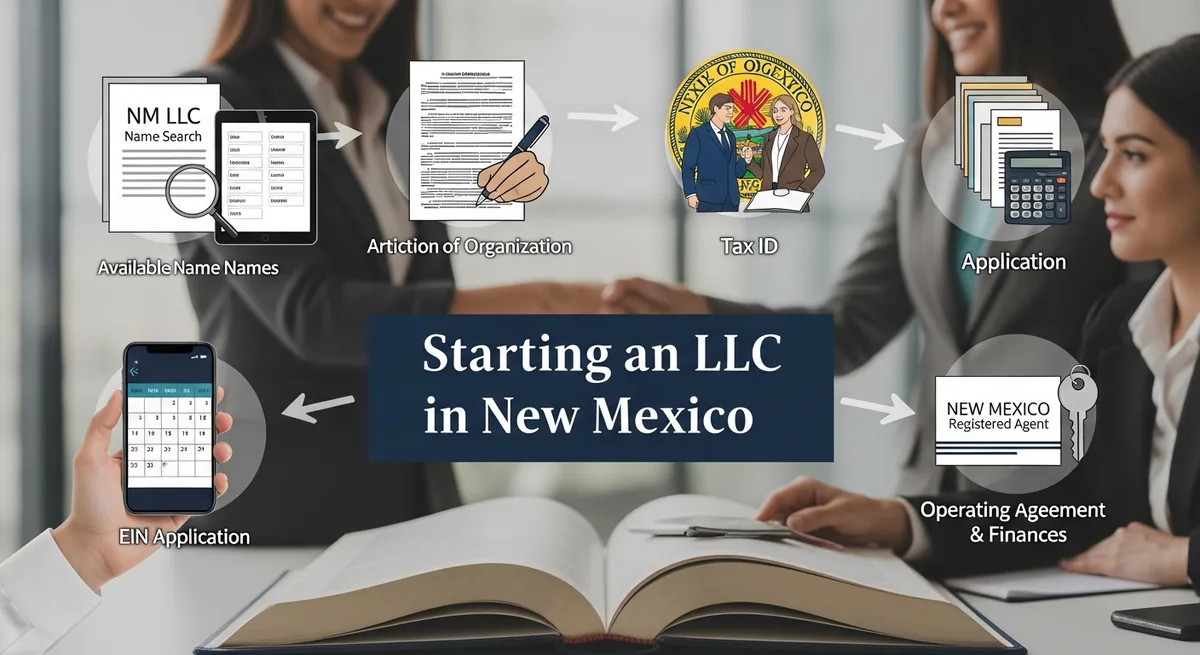
If you’re researching how to start an LLC in New Mexico, you’ve probably already noticed two things that make this state genuinely unusual: the $50 filing fee is one of the lowest in the country, and New Mexico is the only state where you can form a fully anonymous LLC without using a complicated trust or holding-company workaround. That combination — cheap, private, no annual report, no franchise tax — has made New Mexico the quiet favorite among real estate investors, online sellers, and consultants who want to keep their name off the public record in 2026.
Before you celebrate, two warnings. First, “anonymous” doesn’t mean tax-exempt or invisible to the IRS — the federal government still wants your beneficial ownership information under the Corporate Transparency Act (more on that in Step 6). Second, New Mexico only makes sense as your formation state if you actually live or operate there. If you’re an Arizona realtor trying to “save on taxes” by forming in New Mexico, you’ll end up registering as a foreign LLC back in Arizona and paying both states — a mistake I see in the inbox at least once a week.
This guide walks through every step in the order you should actually do them, with the real 2026 costs, deadlines, and gotchas. If you’d rather skip the paperwork entirely, ZenBusiness handles New Mexico Articles of Organization for $0 plus the state’s $50 fee, and they’ll include registered agent service for the first year. For most people who just want to be done in an afternoon, that’s the simplest path. If you want to file it yourself, keep reading.
Why Form an LLC in New Mexico?
The honest answer is: form in New Mexico if you live or do business in New Mexico, or if you specifically need the anonymity feature for an asset-holding LLC. Otherwise, form in your home state. The general rule every corporate lawyer I’ve spoken with repeats: form your LLC where you do business, because anything else just adds a layer of foreign-LLC registration in your home state on top of the original New Mexico filing. There’s a deeper explanation in our foreign LLC registration guide if you’re weighing the tradeoff.
That said, New Mexico has real structural advantages for the people it’s right for:
- $50 filing fee. One of the cheapest formation fees in the country in 2026 — well below Massachusetts ($500), Tennessee ($300+), or even Texas ($300).
- No annual report. Ever. New Mexico is one of only a handful of states (alongside Arizona, Missouri, and Ohio for most LLCs) that doesn’t require an annual or biennial report from LLCs. You file once and you’re done with the Secretary of State forever, unless something material changes.
- No state franchise tax on LLCs. Compare that to the $800 California franchise tax floor or the Delaware franchise tax every year.
- True anonymity on the public filing. The Articles of Organization don’t require you to list members, managers, or beneficial owners. The only name on the public record is the organizer — which can legally be your registered agent or formation service. In my experience helping investors set up holding LLCs, this is the single most-requested feature, and New Mexico is the cleanest way to get it.
- Reasonable state income tax. New Mexico’s individual income tax tops out at 5.9% for 2026 — moderate compared to California’s 13.3% top rate, though higher than Texas’s zero.
The catch is the Gross Receipts Tax (GRT), which we’ll cover in Step 7. If you’re selling goods or services to in-state customers, you’re going to deal with it.
Step 1: Choose Your New Mexico LLC Name
Your LLC name has to satisfy three rules under New Mexico Statutes Annotated § 53-19-3:
- It must contain “Limited Liability Company,” “Limited Company,” or one of the abbreviations LLC, L.L.C., LC, or L.C.
- It must be distinguishable from every other entity name already on file with the New Mexico Secretary of State.
- It cannot include words that imply a different entity type (Inc., Corp., Bank, Insurance) without the appropriate authorizations.
How to check name availability. Go to the New Mexico Secretary of State’s Business Services portal at enterprise.sos.nm.gov and use the corporate entity search. Search your proposed name without the LLC suffix to see exact and similar matches. “Distinguishable” is a relatively low bar in New Mexico — adding “Albuquerque” or “Holdings” or “Group” to an existing name will usually clear it, but the Secretary of State has final discretion.
Reserving the name. You can reserve a name for 120 days for $20 by filing an Application for Reservation of Name. I rarely recommend this in New Mexico because the filing fee itself is only $50 and most people are ready to file within a week of choosing a name. The exception is if you’re waiting on a trademark search through the USPTO TESS database and want to lock the name down.
Practical naming tip from formation work. Pick a name that’s also available as a .com domain and as a username on the social platforms you’ll use. The Secretary of State doesn’t care about domains, but a year from now you’ll wish you had.
Step 2: Appoint a New Mexico Registered Agent
Every New Mexico LLC must designate a registered agent (the state’s term is “registered agent” — same meaning as elsewhere) with a physical street address in New Mexico — P.O. boxes are not allowed — who is available during business hours to accept service of process. This is the person or company who gets handed the lawsuit if someone sues your LLC.
You have three options:
- Be your own registered agent. Free, but your home or business address becomes part of the public Articles of Organization on the Secretary of State website. This defeats the entire anonymity advantage of forming in New Mexico in the first place. If you’re forming in New Mexico for privacy, do not do this.
- Designate another individual (a New Mexico-resident friend, family member, or attorney). The same public-record problem applies — their address goes on the public filing.
- Hire a commercial registered agent service. Typical cost is $99–$300/year. This is the path the vast majority of New Mexico LLCs take, especially anonymous ones, because the registered agent’s address (not yours) appears on the public filing.
For New Mexico specifically, the privacy-focused choice is Northwest Registered Agent at $125/year — they use their own commercial address on every public filing rather than yours, and they were essentially built for the registered agent business. If you want it bundled with formation, ZenBusiness includes a full year of registered agent service free with their Pro plan ($199), which often works out cheaper than buying both separately. LegalZoom also offers New Mexico registered agent service at $299/year — higher priced than the alternatives, but worth considering if you want everything on one billing account with their legal subscription plans. If you want the deeper rationale, our guide on what a registered agent is and why it matters covers it in detail.
Step 3: File the Articles of Organization
This is the document that legally creates your LLC. In New Mexico it’s called the Articles of Organization (Form DLLC-AO), and you file it with the Business Services Division of the Secretary of State.
Filing fees in 2026:
- Standard filing: $50 (online or paper — same fee)
- Expedited processing: New Mexico does not offer formal expedited service; online filings are typically approved within 1–3 business days
Where to file. The Secretary of State’s online filing portal at enterprise.sos.nm.gov. I strongly recommend filing online — paper filings sent to PO Box 1269, Santa Fe, NM 87504 can take 2–4 weeks to process and don’t give you a faster path to your filed-stamped certificate.
What information you’ll need:
- LLC name (with the required suffix)
- Street and mailing address of the principal office (this can be your registered agent’s address if you’re using a commercial service — and this is the privacy trick most filers use)
- Name and street address of your registered agent
- Whether the LLC has a specific dissolution date or is perpetual (almost always perpetual)
- Whether the LLC is member-managed or manager-managed (we explain the difference in our member vs manager-managed guide — short version: most small businesses choose member-managed)
- Name and signature of the organizer — this can legally be your registered agent, your attorney, or your formation service, which is how anonymous filers keep their own name off the public record
You do not need to list members, managers, or beneficial owners on the Articles of Organization. That’s the heart of the New Mexico privacy advantage in 2026.
If you’re filing yourself for anonymity, the typical setup is: use the commercial registered agent’s address as the principal office, and have the registered agent (or a formation service like ZenBusiness or Northwest) act as the organizer. Your name never touches the public filing.
Step 4: Draft an Operating Agreement
New Mexico does not legally require an operating agreement, but skipping one is one of the most common mistakes I see new filers make. Without an operating agreement, your LLC defaults to the rules in New Mexico’s Limited Liability Company Act — and the default rules are not what most people actually want.
An operating agreement is the internal contract among the LLC’s members. It covers:
- Who owns what percentage of the LLC
- How profits and losses are split (which can be different from ownership percentage)
- Who has authority to sign contracts, open accounts, hire employees
- How new members can be added or existing ones bought out
- What happens if a member dies, divorces, or goes bankrupt
- How the LLC will be dissolved if the members part ways
For a single-member LLC, the operating agreement is also one of the strongest documents you have to prove the LLC is a real, separate entity if you’re ever sued and the other side argues for “piercing the corporate veil.” In my experience reviewing single-member LLCs, the ones that hold up in court have three things: a signed operating agreement, a separate bank account, and clean records of contributions and distributions.
If you need a starting template, our LLC operating agreement guide walks through every section you should include. Formation services include this — ZenBusiness provides a customizable operating agreement template starting at their $199 Pro plan, and LegalZoom bundles one with their business formation packages.
Step 5: Get an EIN from the IRS
Your LLC needs an Employer Identification Number (EIN) — the federal tax ID — for almost everything practical: opening a business bank account, hiring employees, paying federal taxes, or applying for credit cards in the LLC’s name.
How to get one. Apply directly with the IRS, free, at irs.gov/businesses. If you’re a U.S. citizen or resident with a Social Security Number, the online application takes about 10 minutes and the EIN is issued immediately.
For non-U.S. residents. If you don’t have an SSN or ITIN (a common situation for non-resident owners using New Mexico LLCs for U.S. e-commerce or holding U.S. real estate), you cannot use the online IRS application. You have to file Form SS-4 by fax or mail, which typically takes 4–8 weeks. Formation services like ZenBusiness and Tailor Brands will handle this process for non-residents for an additional fee — typically $79–$199 — and shave a few weeks off the timeline.
A privacy gotcha. The EIN application asks for a “Responsible Party” — the individual who controls or owns the LLC. The IRS will not let you list the registered agent here; it has to be an actual person. The Responsible Party information is not public, but it’s on file with the IRS, so the anonymity you have on the public Secretary of State filing doesn’t extend to the federal tax record. That’s by design.
Step 6: File Your BOI Report (Beneficial Ownership Information)
This is the step that catches a lot of New Mexico LLC owners off guard in 2026.
Under the federal Corporate Transparency Act, most LLCs formed in the United States must file a Beneficial Ownership Information (BOI) Report with FinCEN (the Financial Crimes Enforcement Network), disclosing the name, date of birth, address, and ID number of every beneficial owner — meaning anyone who owns 25%+ of the LLC or exercises substantial control.
Deadlines:
- LLCs formed in 2024 or later must file within 90 days of formation (if formed in 2024) or 30 days (if formed in 2025 or later)
- LLCs formed before 2024 had to file by January 1, 2025
The BOI report itself is not public — only law enforcement and certain financial institutions can access it — but it is mandatory. The penalty for not filing is up to $591 per day (adjusted for inflation in 2026) and potential criminal charges.
This is the most common “I formed an anonymous New Mexico LLC and thought I was done” trap. Anonymous to the public is not the same as anonymous to the federal government. You still have to file. Our full BOI report guide walks through who has to file, who’s exempt, and how to file directly at FinCEN’s portal — there’s no fee.
For background on which entities are exempt, see our piece on who is exempt from BOI reporting — most LLCs are not exempt, including the typical anonymous New Mexico holding LLC.
Step 7: Understand New Mexico Taxes (GRT, CRS, and State Income Tax)
Here’s where the “tax savings” myth around New Mexico LLCs falls apart for a lot of out-of-state filers.
Gross Receipts Tax (GRT). This is New Mexico’s version of a sales tax — but it’s broader. GRT applies to gross receipts from doing business in New Mexico, not just retail sales. The combined state and local GRT rate ranges from about 4.875% to 9.4375% depending on the municipality in 2026. If you’re an Albuquerque-based consultant, you owe GRT on your service revenue. If you’re a Santa Fe retailer, you owe GRT on your sales. According to the New Mexico Taxation and Revenue Department, most active New Mexico businesses register for a CRS identification number to handle GRT, withholding tax, and compensating tax in one system.
State income tax. New Mexico’s individual income tax for 2026 is progressive, with rates ranging from 1.7% on the first bracket up to 5.9% on income over $315,000 (single filers). LLCs are pass-through entities by default, so the LLC itself doesn’t pay income tax — the members pay it on their personal returns.
The “no tax” myth. If you live in California and form a New Mexico LLC, you do not escape California taxation. California taxes its residents on their worldwide income. The New Mexico LLC will need to register as a foreign LLC in California ($70 + $800 annual minimum franchise tax) if it’s doing business there, and you’ll pay California income tax on your share of the LLC’s income regardless of where the LLC was formed. This is one of the most common misconceptions about anonymous out-of-state LLCs, and it’s been the subject of more than one Bloomberg reporting cycle on tax-planning crackdowns since 2024.
The federal tax election. A single-member LLC is taxed as a sole proprietorship by default; a multi-member LLC is taxed as a partnership. Either can elect to be taxed as an S-corp (or C-corp) by filing Form 2553 with the IRS. The S-corp election can save self-employment tax for owners who pay themselves a reasonable salary plus distributions, but it adds payroll complexity and is rarely worth it under roughly $80,000–$100,000 of net profit. We cover the math in LLC vs S-corp: which is better for taxes.
Step 8: Open a Business Bank Account and Set Up Bookkeeping
Once you have your filed-stamped Articles of Organization, your operating agreement, and your EIN, the next move is a dedicated business bank account. Do not mix LLC money with personal money. This is the single thing that turns a paper LLC into a real, veil-protected LLC in a courtroom.
You’ll need:
- Filed-stamped Articles of Organization (download from the Secretary of State portal after approval)
- EIN confirmation letter (the CP 575 from the IRS, or your online confirmation PDF)
- Operating agreement (most banks ask for this even for single-member LLCs)
- Government-issued ID for every authorized signer
New Mexico has the usual mix of national banks (Wells Fargo, Chase, Bank of America) and regional players like Nusenda Credit Union, Western Commerce Bank, and the New Mexico Bank & Trust branches. For most online-first businesses, I find a fintech business account (Mercury, Bluevine, or Relay) opens faster and integrates with bookkeeping software like QuickBooks or Wave more cleanly than a brick-and-mortar bank.
The two-account rule. From day one: one checking account and one savings or tax-reserve account, both in the LLC’s name. Move 25–30% of every payment into the tax-reserve account the day it lands. If you make quarterly estimated tax payments (which you almost certainly will), having that money already separated saves you the panic in April.
Step 9: Stay Compliant Going Forward
The good news about New Mexico is that there is no annual report and no franchise tax. The bad news is that “no annual report” lulls some owners into thinking there’s nothing to do. There is.
Ongoing compliance for a New Mexico LLC in 2026:
- Maintain your registered agent. If your agent resigns or moves, you have to update the filing. If the state can’t reach you, your LLC can be administratively dissolved.
- File and pay GRT monthly, quarterly, or semi-annually depending on your revenue, via the New Mexico Taxation and Revenue Department’s TAP portal.
- File state and federal income tax returns every year — the LLC files an informational return (or none, for single-member LLCs), and the members report income on personal returns.
- Update the BOI Report within 30 days of any change in beneficial ownership, address, or ID document.
- Maintain corporate formalities — keep the operating agreement updated, document major decisions in writing, and keep clean books.
If anything changes — new members, name change, principal office move, manager-vs-member-management change — you file an Articles of Amendment with the Secretary of State for $50. To dissolve the LLC voluntarily, you file Articles of Dissolution for $25.
How Much Does It Really Cost to Form an LLC in New Mexico?
Here’s the realistic 2026 budget for a New Mexico LLC, from cheapest to most hands-off:
| Approach | Year 1 Cost | What’s Included |
|---|---|---|
| File yourself, be your own registered agent | $50 | State filing only. Loses anonymity. |
| File yourself + commercial registered agent | $149–$350 | $50 state fee + $99–$300 registered agent |
| ZenBusiness Starter | $50 | $0 service + $50 state fee, no registered agent year 1 |
| ZenBusiness Pro | $249 | $199 service + $50 state fee, registered agent free year 1, operating agreement |
| LegalZoom Economy | $149 | $99 service + $50 state fee |
| Tailor Brands Lite | $50 | $0 service + $50 state fee, branding tools |
| Inc Authority Free | $50 | $0 service + $50 state fee, free registered agent year 1, upsells in checkout |
| Northwest Registered Agent | $189 | $39 service + $50 state fee + $100 registered agent (first year) |
| Bizee Silver | $50 | $0 service + $50 state fee, free registered agent year 1 |
| LLC Attorney | $149+ | $99+ service + $50 state fee, attorney-prepared documents |
A few notes from researching these in detail. Inc Authority is genuinely free but has the heaviest upsell flow during checkout in the industry — I went through the full signup last month and counted nine upsells before I reached the final confirmation page. If you’re a price-sensitive filer who can ignore the upsells, it’s a legitimate $50 path. Bizee is the cleanest free option but renews the registered agent at $119/year after year one — worth comparing against Northwest at $125/year, which is more privacy-focused. Unlike LegalZoom which charges $299/year for registered agent service, both Bizee and ZenBusiness renew cheaper. For a side-by-side, our ZenBusiness vs LegalZoom comparison walks through every line item.
Common Mistakes That Cost New Mexico LLC Owners Real Money
After helping people form LLCs in five states personally and reviewing dozens more, these are the most expensive mistakes I see repeated in New Mexico specifically:
- Forming in New Mexico while operating elsewhere. If you live in Texas and run an Etsy shop out of your Austin home, you owe Texas the foreign LLC registration ($750 in 2026) plus Texas franchise tax filings. The New Mexico anonymity doesn’t follow you to Texas. Just form in Texas.
- Using your home address as the principal office on the Articles of Organization. That defeats the entire privacy advantage. Use a commercial registered agent’s address.
- Skipping the BOI report because the LLC is “anonymous.” Anonymous to the public, not to FinCEN. Skipping the BOI report risks $591/day fines in 2026.
- Mixing personal and business funds. This is veil-piercing 101. In every state, including New Mexico, courts can ignore the LLC structure and reach personal assets if you don’t keep separate books.
- Not registering for a CRS number for GRT. If you’re doing business in New Mexico and not registered for GRT, you’ll get a back-tax bill plus penalties when the state catches up — and they do catch up, especially with automated 1099-K cross-matching that’s expanded significantly since 2024.
- Treating the registered agent as optional. If your registered agent resigns and you don’t replace them, the state administratively dissolves your LLC. Reinstatement is doable but messy. See what happens if you don’t renew your LLC for the full domino effect.
Frequently Asked Questions
How much does it cost to start an LLC in New Mexico?
The state filing fee for Articles of Organization is $50 in 2026 — one of the lowest in the country. Total realistic first-year cost ranges from $50 (DIY, no registered agent service) to about $349 (with a registered agent service and an operating agreement). If you want to skip the paperwork entirely, ZenBusiness offers a $0 + state fee formation package.
How long does it take to form an LLC in New Mexico?
Online filings through the New Mexico Secretary of State’s portal are typically approved in 1–3 business days in 2026. Paper filings mailed to Santa Fe take 2–4 weeks. New Mexico does not currently offer formal expedited processing, so the online portal is your fastest path.
Do I need to live in New Mexico to form a New Mexico LLC?
No. Anyone can form a New Mexico LLC — you do not need to be a New Mexico resident or even a U.S. citizen. You do need a registered agent with a physical New Mexico address, which is why most non-residents use a commercial registered agent service. The catch is that forming in New Mexico while operating in another state usually requires foreign LLC registration in your home state, which often costs more than just forming at home would have.
Is a New Mexico LLC really anonymous?
The public Articles of Organization filed with the New Mexico Secretary of State don’t require members, managers, or beneficial owners to be named — only the organizer and registered agent. In that sense, yes, it’s the most privacy-friendly state in the country in 2026. However, you still have to disclose beneficial owners to FinCEN under the federal BOI report requirement, and to the IRS when you get your EIN. “Anonymous to the public” is not the same as “anonymous to law enforcement.”
Does a New Mexico LLC have to file an annual report?
No. New Mexico is one of the rare states that does not require LLCs to file an annual or biennial report. Once your Articles of Organization are approved, you have no ongoing filing with the Secretary of State unless you amend the articles (name change, registered agent change, etc.).
What is the cheapest way to start an LLC in New Mexico?
The absolute cheapest is filing yourself directly with the Secretary of State for the $50 state fee and acting as your own registered agent. But that puts your home address on the public record. The cheapest path that preserves privacy is using a free-tier formation service like Inc Authority or Bizee, which include a free year of registered agent service, then paying $99–$125/year for the registered agent in year two.
Do I need an attorney to start an LLC in New Mexico?
No. The Articles of Organization are a simple one-page form, and the operating agreement can be drafted from a template for a single-member or simple multi-member LLC. You need an attorney if you have complex member arrangements, multiple investment classes, real estate held in the LLC, or specific tax-planning structures. For those cases, LLC Attorney offers attorney-prepared formation starting at $99 plus state fee — middle ground between DIY and a full-fee local lawyer engagement.
What’s the difference between Articles of Organization and an operating agreement?
The Articles of Organization is the public document filed with the New Mexico Secretary of State that creates the LLC. The operating agreement is the private internal contract among the members that governs how the LLC actually runs. Articles of Organization are required; operating agreements are not legally required in New Mexico but are strongly recommended for every LLC.
Final Thoughts: Is a New Mexico LLC Right for You?
If you live and work in New Mexico, the answer is straightforward — yes, form here. The $50 fee, no annual report, no franchise tax, and privacy advantages make it one of the most owner-friendly states in 2026.
If you live elsewhere, the question is whether you specifically need the anonymity feature. For an asset-holding LLC where the goal is to keep your ownership off the public record (real estate investors, web property holders, intellectual property holders), a New Mexico LLC paired with a commercial registered agent is a genuinely clean structure. For a typical operating business in another state, the foreign-LLC registration costs and home-state taxes will eat the savings, and you’re better off forming where you actually do business — see our guides for Texas, Florida, California, or Delaware.
Whichever path you take, the mechanics are the same: pick a name, appoint a registered agent, file the Articles of Organization, draft an operating agreement, get your EIN, file the BOI report, register for GRT if applicable, and open a business bank account. The whole sequence can be done in a single afternoon if you have your paperwork in order, or in 10 minutes if you let ZenBusiness handle it.
For a broader view of how the major formation services compare on pricing, features, and customer support, our best LLC formation services hub ranks the top seven providers head-to-head, and ZenBusiness consistently lands at the top for value across most state filings, with LegalZoom as the strongest alternative for filers who want everything bundled with broader legal services.
The author name used in this article may be a pen name or pseudonym and is used for illustrative and editorial purposes only. This article is for informational purposes only and does not constitute investment, tax, or legal advice. State filing fees, tax rates, and regulatory requirements can change — verify current details with the New Mexico Secretary of State and the New Mexico Taxation and Revenue Department before filing. Consult qualified professionals before making financial decisions.

Sarah Mitchell
Sarah has researched and tested over 20 LLC formation services since 2021. She has personally formed LLCs in 5 states.